The Wobble Everyone Recognises
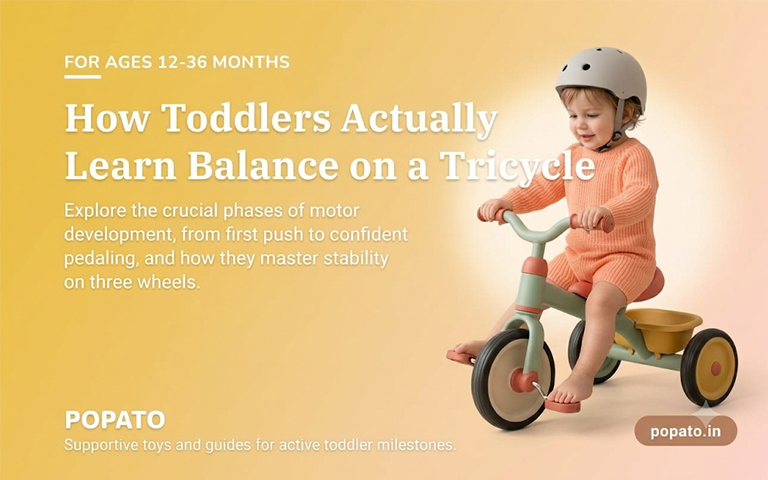
Picture a small rider on a pavement, tongue poking out in concentration, legs working, handlebar swinging left and right. A few steps behind, a parent hovers with arms half-extended, ready to catch.
It’s a scene played out in parks and society compounds everywhere. And it carries a quiet assumption: that balance is something we teach, usually by holding the seat and running alongside.
But child-development experts often describe it differently. Balance isn’t a trick you hand over on the day of the first bike ride. It’s a skill that builds, quietly, from the first time your baby holds their head up. By the time a toddler climbs onto a ride of their own, they’ve already been practising for months.
So what is actually happening in that wobbling little body?
Stage 1: Balance Begins Before the Bike (Around Ages 1 to 2)
Long before pedals, a toddler is learning where their body is in space. Sitting upright, steadying the head, feeling the world move past: all of it trains the inner-ear and core systems that balance depends on.
This is why a parent-steered first ride isn’t just a convenience. When a child sits in a padded, supportive seat with a harness and watches the pavement roll by, they’re building posture, head control and comfort with movement. They don’t have to do anything except sit tall and look around.
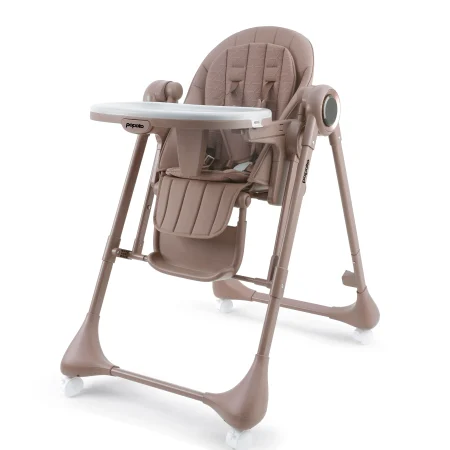
The same upright-sitting practice happens at the table. A well-designed high chair for baby, with a supportive back, a footrest and a snug harness, helps little ones sit tall through mealtimes, which supports the posture they’ll later need on a ride.
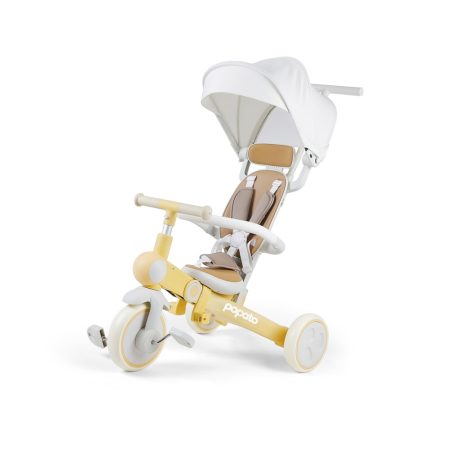
This is the stage the Popato T-7 was designed around. It begins as a parent-steered stroller trike, with a padded adjustable seat, a safety harness and a removable push handle, so the earliest outings feel secure for both of you. Every change on the T-7 is tool-free, which matters when you’re juggling a toddler and a park bag.
Stage 2: Pedaling Is Not Balancing (Around Ages 2 to 3)
Here’s the part that surprises most parents. On a three-wheeler, the trike holds itself up. So when a toddler first pushes the pedals, they’re learning leg strength, rhythm and coordination, not balance.
That’s not a lesser skill. Pushing pedals in a circle is genuinely hard for little legs, and many children go through a phase of pedaling backwards, or not at all, before it clicks. The best thing a parent can do is stay patient and let them experiment.
As your child gets ready, the T-7 transitions into a standard pedal tricycle, and the footrest folds away once they’re pedaling on their own. It’s the same frame, just a new job. The Popato T-9 takes this idea further, with a 9-in-1 design built to adapt through more stages of growth than a standard tricycle.
Stage 3: The Balance-Bike Leap (Around Ages 2.5 to 4)
This is where balance itself is learned. On a balance bike, a child sits low, feet on the ground, and moves by pushing off. Every wobble is recoverable: put a foot down and you’re fine. That safety net is what lets a child lean, steer and trust the bike.
Many educators and cycling coaches suggest that learning balance first makes the move to a pedal bike far smoother, because the child already knows how to stay upright and only has to add pedaling. It’s the reverse of the old approach of training wheels first.
The Popato B-4 is built for this journey. It moves through Push Mode, with a parent steering handle for early strolls, then Balance Mode to build coordination, then Bicycle Mode as a standard pedal bike for independent riding, plus a Folded mode for storage and carrying. The T-7 can also convert into a balanced bike on the same core frame.
The Small Detail That Matters: Seat Height
If there’s one thing worth checking every few weeks, it’s the seat. A child who can plant both feet flat on the ground feels safe enough to try. A child on tiptoe will freeze.
That’s why adjustable seat height and a grow-with-child handlebar matter more than they sound. It’s the same logic behind a premium high chair for toddlers with an adjustable footrest: when the feet are steady, the whole body is steadier. A toddler’s legs can lengthen noticeably in a season, and a ride that adjusts keeps that sense of security intact.
One Idea, Many Countries: Stage-by-Stage Rides
This stage-by-stage thinking isn’t unique to one brand or one country. Across the US and Europe, brands like JMMD have built push, balance and pedal rides around the same principle: a child’s needs change quickly between ages 1 and 4, so a single ride that changes with them makes more sense than buying a new one every few months.
It’s a smart idea, and Indian parents have noticed. Searches for JMMD and similar grow-with-me toddler bikes keep coming from India. The catch is that reaching an Indian doorstep usually means international shipping, import duties and customs paperwork on top of the sticker price, along with the question of who to call if something needs support.
That’s the gap Popato set out to close. Our rides follow the same stage-by-stage design thinking, but they’re sold here in India, with local delivery, local support and no separate customs charges landing on you at the door.
If you’ve been looking at JMMD toddler bikes or tricycles and wondering whether there’s an option closer to home, it’s worth comparing on the things that matter to your family rather than just the look:
- Stages Covered: Does it handle push, pedal and balance, or only one?
- Seat and Handlebar Adjustment: Will it still fit in a year?
- Storage and Travel: Does it fold small enough for your car boot or apartment corner? Both the T-7 and B-4 fold down compactly for exactly this reason.
- After-sales support: Is there someone local to call?
- Total Cost: Compare the final price at your door, including shipping and duties, not just the listed price.
What Parents Can Actually Do
Whatever ride you pick, a few habits help toddlers build balance faster and more safely:
- Let them wobble: Small wobbles are how balance gets trained. Resist the urge to correct every one.
- Choose flat, smooth surfaces: A quiet pavement, a clear terrace or a society driveway beats a bumpy path.
- Keep sessions short: Ten to fifteen focused minutes is often better than a long, tiring outing.
- Always use a helmet: Make it a non-negotiable from the very first ride.
- Don’t rush the milestones: Some children glide at two and a half, others at four. Both are normal.
- Follow your child’s lead: If they want to stay on the trike a little longer, that’s part of the process, not a delay.
Back to the Pavement
That wobbling rider from the start? Give them a few weeks. One day, the feet will lift, just for a second, and the bike will carry on straight, balanced and entirely on its own. You’ll probably forget to breathe.
They didn’t learn that in a day. They learned it from every stage that came before: the early outings in the seat, the first awkward pedal pushes, the first time both feet left the ground. Choosing a ride that supports each of those stages is how you give them the best shot at that moment.
Explore the Popato range: the T-7 and T-9 multifunctional tricycles, and the B-4 4-in-1 convertible bicycle, all designed for children aged 1 to 4 years.
READ MORE: How to Choose a High Chair for Your Kids?